
I will now briefly discuss antipsychotics, mood stabilizers, and similar drugs as far as they may be useful for the treatment of “normal” mental disorders (non-psychotic states) such as anxiety or depression.
Antipsychotics
Once upon a time, the serendipitous discovery of chlorpromazine emptied asylums pretty quickly. Furthermore, the finding that an exogenous molecule can literally cure some of the most insane forms of mental illness paved the way for treating disorders of the “mind” with biological intervention. Modern psychiatry was born.
Antipsychotics block dopamine signaling (and usually a host of other signaling pathways as well). By blocking the D2-receptor, antipsychotics remove hallucinations and other idiosyncratic “weirdnesses,” but they also cause avolition, apathy, anhedonia, and kill libido, punch, and drive. APs were designed to take out life force and are essentially “anti-stimulants”.
On the upside, APs reduce “weird” thinking patterns, racing thoughts and rumination, and the tendency to harm oneself and others. They are usually reserved for disorders falling on the schizophrenic or bipolar spectrum and they are often used as augmentation agents in certain cases of anxiety, depression, eating disorders, and OCD.
Generally speaking, there are few drugs out there that alter personality (which is the pattern of feeling, thinking, and acting) as much as antipsychotics. A friend of mine who works with maladjusted children claims that most of the kids he works with are unrecognizable after they are prescribed antipsychotics – and not in a good way.
My thoughts on quetiapine and olanzapine for the treatment of depression
At higher than hypnotic dosages, quetiapine and olanzapine are ultra “dirty” drugs (pharmacologically speaking), blocking dopaminergic, serotonergic, histaminergic, adrenergic, and cholinergic receptors, depending on their specific binding profile.
Because they block so many receptors, taking antipsychotics leads to a widespread impairment in emotion, cognition, motivation, and behavior – though clinically useful at times, such as with schizophrenia, mania, anxiety disorders, OCD, autism, agitated dementia, and tantrum-throwing children.
Quetiapine is widely used for almost everything but it’s not the most effective remedy for any of these things.
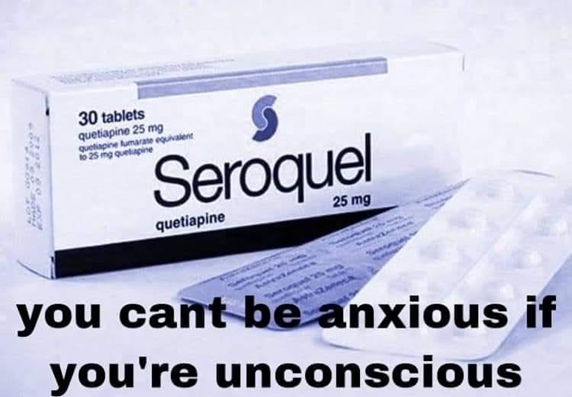
Quetiapine is frequently prescribed as an adjunct to antidepressants in the treatment of depression and for some weird reason, psychiatrists love doing this – presumably because it calms people down without having to talk to them and without a risk of addiction.
I am probably not getting a lot of shit for writing this because few psychiatrists read frivolous blogs, but in my opinion, using antipsychotics in the treatment of non-psychotic depression is among the worst ideas of psychiatry (and psychiatry has a lot of them). Sure, there are some cases in which quetiapine helps (e.g., self-harm, excessive rumination) but most people are, in my opinion, net harmed by it.
Antipsychotics reduce the MADRS and HAM-D scores (the main depression scores in clinical use) in part because they make people sleep longer and eat more (which artificially improves scores), and because they reduce the activity of circuits responsible for rumination and anxiety (because they reduce the activity of circuits responsible for feeling and thinking in general). These effects lead to an artificial reduction in depression scores without often actually making the depression better.
If high doses of certain antipsychotics are prescribed to the “wrong” person (i.e., everyone who is not an active bipolar or schizophrenic) patients usually “die inside” as antipsychotics tend to kill personality, ambition, libido, emotions, social intelligence, athleticism, the ability to cognize, the interest in learning, the love for hobbies, and the drive to improve oneself. Unfortunately, in my opinion and experience, the overprescription of antipsychotics is common.
In a sense, antipsychotics can be compared to a whole-brain chemical lobotomy. While dulling senses, thoughts, and emotions are surely warranted in cases of psychosis and mania, trading in misery for zombification and emptiness is hardly a productive long-term strategy in the treatment of depression (unless the patient desires to be dead inside – and some patients definitely do).
A little more useful
Besides the use of low-dose antipsychotics for sleep/insomnia, there are three of them that can be somewhat useful at times.
Risperidone
A psychiatrist friend of mine frequently prescribes very low-dose risperidone (e.g., 0.5mg) to help with cases of anxiety or depression characterized by intrusive thoughts, obsessive tendencies, compulsive behaviors, or excessive rumination. In my opinion, probably overkill.
Aripiprazole & cariprazine
In psychiatry, aripiprazole (or the newer brexiprazole) is regarded as “the great normalizer”. Aripiprazole and cariprazine are partial D2/D3 agonists, among many other things. They reduce dopamine signaling when and where dopamine levels are high and elevate dopamine signaling when and where levels are low.
A low dose of 1-2mg aripiprazole may be useful in certain cases of depression.
Amisulpride
While amisulpride is a “normal” antipsychotic agent at clinical doses, a very low dose amisulpride (VLDA) leaves D2-receptors mostly untouched but predominantly blocks D3 autoreceptors, which is thought to disinhibit dopamine release and is therefore thought to amplify dopamine signaling (instead of reducing it).
Furthermore, amisulpride blocks 5-HT2B and 5-HT7 receptors, both of which have been shown to restrict the release of dopamine. Amisulpride also acts as an agonist of the GHB receptor, which promotes the release of dopamine and glutamate. For this reason, in some countries, VLDA is used to treat dysthymia and anhedonia.
Subscribe to the Desmolysium newsletter and get access to three exclusive articles!
Mood stabilizers
In the treatment of bipolar disorder, mood stabilizers, as their name suggests, stabilize mood, which means that they reduce the tendency to cycle into mania or depression. Mood stabilizers are also somewhat frequently used in the treatment of a number of other psychiatric disorders, such as anxiety or depression.
Mood stabilizers include lithium and a host of antiepileptic drugs.
Lithium
The amount of lithium in the soil has been successfully correlated with suicide rate. Lithium salts have a variety of effects on the nervous system. The “exact” mechanism of action is unknown but includes likely multiple different effects.
How exactly lithium works is not fully known, though it seems to boost a variety of neurotransmitters, specifically serotonin. It is hypothesized that lithium inhibits a intracellular kinase named GSK-3, which is involved in a variety of intracellular pathways.

Unfortunately, lithium has a narrow therapeutic range, and may even have some toxic effects if blood levels are within that range, for example, on the thyroid gland and kidney health.
Nonetheless, lithium is an effective treatment for bipolar disorder and a useful augmentation agent for a variety of mental disorders – especially depression. A friend of mine who has tried lithium therapy for (suspected) bipolar disorder said that he felt like a “robot” while on it.
Microdosing lithium
Anecdotally, some people experience great benefits in terms of mood and emotional stability from a microdose of lithium, such as 5mg lithium orotate taken at night. For others, even a microdose can result in emotional flatness.
Interestingly, the amount of lithium in the groundwater is correlated with the suicide rate of a particular area.
Adding a microdose of lithium is also known to improve the response to various antidepressants.
Of note, the longevity physician Peter Attia and “lifestyle guru” Tim Ferris have been taking microdoses of lithium for years, specifically to help with stress and emotional regulation. Anecdotally, a friend of mine said he experiences “profound” mental changes with just 5mg of lithium orotate, particularly in his mood.
Lamotrigine
Lamotrigine blocks voltage-gated sodium and calcium channels. While its primary use is epilepsy treatment, it is widely used off-label for a variety of conditions, including bipolar disorder, pain syndromes, depression, OCD, migraines, and hallucinogen-persistent perceptive disorder.
Sources & further information
- Textbook: Stahl’s Essential Psychopharmacology: Neuroscientific Basis and Practical Applications
- Website: Wikipedia – Antipsychotic
- Scientific article: Mood Stabilizers
Disclaimer
The content available on this website is based on the author’s individual research, opinions, and personal experiences. It is intended solely for informational and entertainment purposes and does not constitute medical advice. The author does not endorse the use of supplements, pharmaceutical drugs, or hormones without the direct oversight of a qualified physician. People should never disregard professional medical advice or delay in seeking it because of something they have read on the internet.