
Last year I ran an experiment to gain 1kg per month for 8 months, which elevated my energy and mood quite a bit. Throughout this time, my self-worth steadily increased and my feeling of not being “good enough” quieted down considerably. Sure, I also worked on myself in psychotherapy, but I believe the biggest effect on my self-worth came from simply having greater energy levels.
This should be no surprise, because in states of hypomania (a state of boundless energy and great mood), feelings of grandeur are common. In mania (hypomania gone berserk), self-worth can increase to pathological levels (e.g., considering oneself “the chosen one”). Many leaders with particularly high self-worth are hypomanics in terms of energy levels.
Similarly, during dysthymia (a state of poor energy and poor mood), feelings of low self-worth are common. In depression, this is even worse, and self-loathing is common.
So, as people go from depression, to dysthymia, to euthymia, to hypomania, to mania, self-worth steadily increases. What these states have a lot in common is that they are all gradations in energy levels – mood is often secondary.
Sure, if self-worth increases (e.g., from psychotherapy), one could argue that the arrow of causality is reversed. But that still does not change the fact that state transitions (and self-worth changes) are often brought about by purely biological changes.
A good example is the female menstrual cycle.
During the early follicular phase (menstruation, day 1 to day 5), estrogen and progesterone are low. Many women report feeling tired, more introspective, or emotionally vulnerable. During the mid-follicular phase (day 5 to day 12), estrogen rises, boosting mood, confidence, motivation, and often self-esteem. During the ovulatory phase (day 13 to day 16), estrogen peaks, and there is a brief spike in testosterone. This often leads to heightened self-worth, assertiveness, libido, and a sense of vitality. Studies show women tend to feel more attractive and socially dominant during this window. Self-worth is generally at its peak.
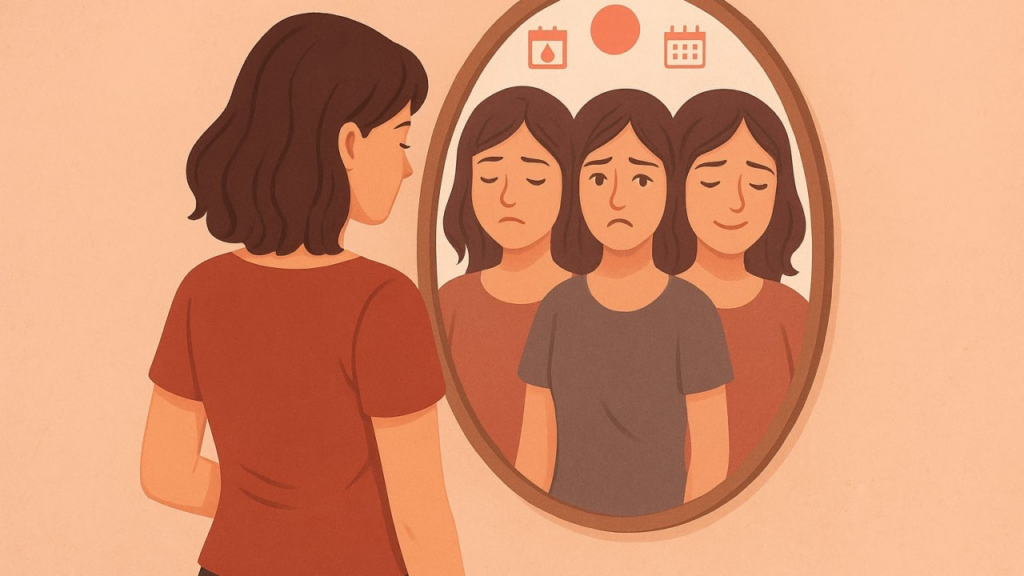
In the late luteal phase (day 22 to day 28), many women experience increased self-criticism, moodiness, sadness, anxiety, or body image issues. Those with PMDD (premenstrual dysphoric disorder) often report pronounced negative self-perception.
Obviously, some women have more pronounced changes in self-worth during the menstrual cycle (particularly those prone to PMS), whereas others have barely any.
My point is that feelings of self-worth, something generally thought of as “psychological” and relegated to the domain of psychotherapy, can be readily and powerfully brought about by biological changes.
Consequently, and unconventionally, one can increase feelings of self-worth by boosting vitality (particularly energy levels), the means do not matter – whether that means eating more, exercising, sleeping better, or antidepressant drugs.
(This is not to say that psychotherapy or psychological changes are not effective for changing one’s feeling of self-worth. They are!)
Weekly observations
This article was a weekly observation, shared via my newsletter. The full archive can be found here.
Disclaimer
The content available on this website is based on the author’s individual research, opinions, and personal experiences. It is intended solely for informational and entertainment purposes and does not constitute medical advice. The author does not endorse the use of supplements, pharmaceutical drugs, or hormones without the direct oversight of a qualified physician. People should never disregard professional medical advice or delay in seeking it because of something they have read on the internet.