
I do believe that the importance of how my voice sounds is underestimated in how others perceive me – not just in dating. A deep and vibrating documentary narrator voice has soothing properties – even if listeners cannot consciously tell that they are being influenced. Many podcast hosts do voice training particularly for this reason.
For a long time, my voice has not been as deep and as resonant as I would like. Particularly when I was lean, I severely disliked the sound of my voice and it was a big insecurity.
I found out that whenever I gained some fat, my voice got somewhat better. And whenever I started to take molecules that cause water retention, such as creatine or fludrocortisone (a synthetic aldosterone analog), my voice got much better overnight.
Jitter improved, shimmer improved (two measures of vocal quality) and my fundamental frequency dropped by about 10-15 Hz. Unfortunately, these changes only held up for a limited amount of time.
I tried SOVT (Semi Occluded Vocal Tract) exercises and even took singing lessons but these helped only very little. Many hours wasted.
I sucked on countless hyaluronic acid lozenges while humming, hoping that the hyaluronic acid that is swallowed and is coating the vocal folds will be absorbed into the underlying tissue to some extent. I experimented with pilocarpine to increase the activity of my salivary glands so that my vocal folds are coated with more moisture. Both to no avail.
I found out, that both the resonance and the frequency of my voice seem to be related to vocal fold mass. Whenever I lost fat, neck fat mass declined as well and my vocal cords were less able to touch during phonation.
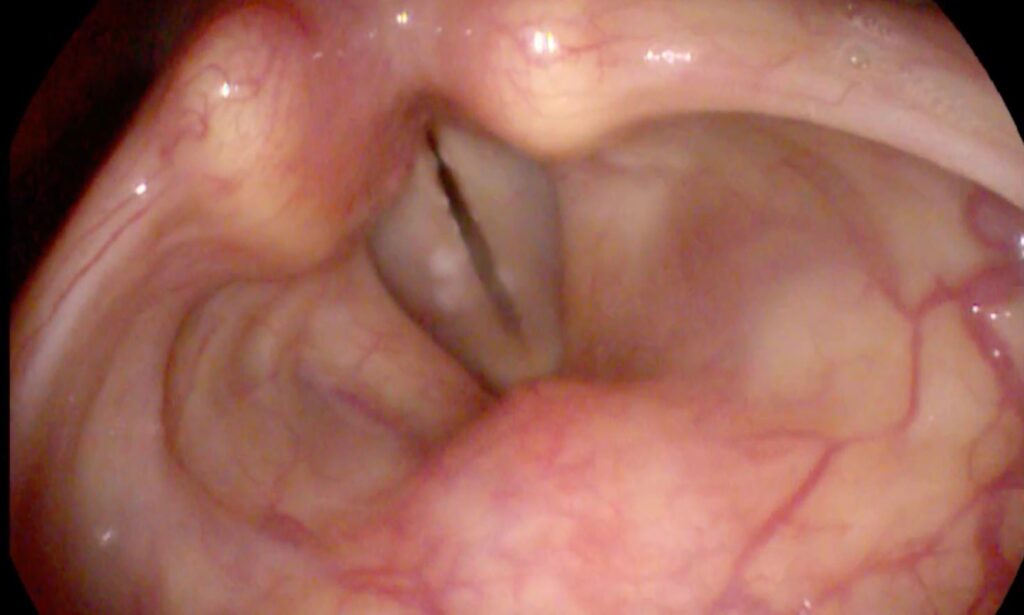
Most importantly, whenever I was dehydrated, my voice became shit. Whenever I was artificially hyperhydrated, my voice was night & day better. Similarly, whenever I went low-carb (insulin leads to water retention) my voice reacted quite negatively.
Like the strings of a guitar, the bigger and longer the string, the deeper the note. The only way “string length” can be affected is by growth hormone or androgens during puberty. Anecdotally, some bodybuilders claim that their voices have gotten deeper as they started to do AAS cycles but there is no way to tell whether that is due to water retention.
Anyway, about a year ago, I decided to have filler injected into my vocal cords experimentally by a good ENT doctor. I opted for a crosslinked hyaluronic acid (the stuff women inject into their face and lips to plump them up). I had 0.15ml injected bilaterally next to the outer lateral part of my vocal fold. To numb the gag reflex, a lot of xylocaine was used, which was sprayed down my throat – this was the hardest and most uncomfortable part and it felt like I was suffocating for 20 minutes as my vocal folds could barely move.
After my “voice lift” I had to rest my voice for 48 hours. The best part was accepting phone calls as I was growling like a dying lion.
Anyway, after 3-4 days, it started to sound completely natural and I loved the result. I went from 120 Hz fundamental frequency (on the 75th percentile of the male spectrum) to 105 Hz – basically going from Elija Wood to Bruce Willis. I just sounded like I normally do – but deeper and more resonant. Here is a clip of me about a week after my voice lift (Link).
Unfortunately, the result only lasted for about a month – presumably because the ENT doctor only injected a very low amount.
If I did this more often, some fibrosis would presumably occur, potentially lowering my pitch permanently, though I decided against it (more later). Even better yet, autologous fat transplantation would be an alternative with the effects in many people being permanent. It is basically a transplantation of abdominal fat (which contains more adipocyte progenitor cells than, e.g., fat from the buttocks region) into the vocal folds to plump them up. Because fat is supple and also endogenous tissue, the vibrating capacity of the vocal folds is not affected and nor is there a prolonged inflammatory reaction because the tissue is non-foreign.
Two months after my hyaluronic acid experiment, I conducted an experiment to gain 1kg per month (gaining 7-8kg in total). My voice quality improved automatically over time, though this could also have been due to my TRT Lite protocol which I started at about the same time. On my TRT lite protocol, my estradiol is about double of what it was before, which causes water retention. Furthermore, estradiol has a trophic effect on the vocal fold lamina propria (the mucosal lining of the vocal folds), which is responsible for holding moisture.
At the moment, my voice is around 115 Hz and is fairly more resonant than before. My new protocol includes:
- 10g of hydrating electrolytes in the morning (containing about 1000mg of sodium): This helps my body to hold a little more water. My electrolyte mix is similar to LMNT but I made it myself as it is a whole lot cheaper.
- 3g of creatine in the morning: This increases intracellular water content and therefore plumps up my vocal muscle a bit. Whenever I stop the creatine, my voice starts to sound worse. Taking it in the morning vs. at night gives the additional benefit of increasing extracellular water by a bit (as more of the hygroscopic creatine monohydrate is in the blood plasma increasing extracellular fluid in addition to intracellular fluid).
- Neck exercises a couple of times per week: Particularly training the sternocleidomastoid muscles (the long muscles on the outside of the neck) relaxes the vocal cords as baseline muscle tone decreases as the muscle gets stronger. At first, I thought this was a broscience thing but after trying it out myself, I could see that it worked. In fact, the effect is immediate. Doing neck exercises to failure improves my vocal quality for a couple of hours because the sternocleidomastoid tone decreases. I use 2x 5kg exercise sandbags instead of a neck harness.
At the moment, my vocal quality has improved so much that I stopped thinking about my voice, which used to be an insecurity of mine.
Weekly observations
This post was sent out to my newsletter subscribers as a Weekly Observation, one of which I share in my newsletter every week. You can find the full archive here.
Disclaimer
The content available on this website is based on the author’s individual research, opinions, and personal experiences. It is intended solely for informational and entertainment purposes and does not constitute medical advice. The author does not endorse the use of supplements, pharmaceutical drugs, or hormones without the direct oversight of a qualified physician. People should never disregard professional medical advice or delay in seeking it because of something they have read on the internet.